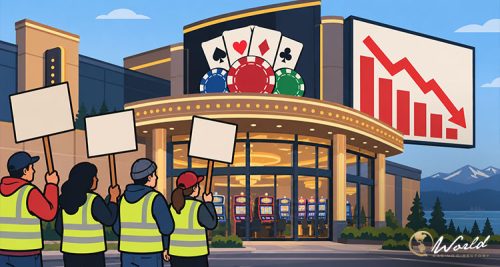
Encore Boston Harbor posted its lowest monthly gaming revenue in over five years, down 22.1% to $46.1 million in September 2026 as a strike involving roughly 1,350 workers dragged on.
Encore Boston Harbor just posted its weakest month in over five years. And no, it wasn't a slow summer or a bad weather stretch. It was a labor strike.
According to the Massachusetts Gaming Commission, the Everett casino pulled in roughly $46.1 million in gross gaming revenue (GGR) during September 2026. That's down 22.1% from the $59.1 million it brought in during September 2025. It's also the lowest monthly total since February 2021, when the property made about $41 million while COVID-19 restrictions were still choking the industry.
### What the Numbers Actually Tell Us
A 22% drop sounds dramatic on paper, and honestly, it is. But context matters here. The strike involved around 1,350 employees, which is a big chunk of the workforce at a property owned by Wynn Resorts. When that many people walk off the job, things slow down. Tables get closed. Service gets stretched thin. And customers notice.
Here's the thing about casino revenue: it's not just about the games. It's about the whole experience. People come for the atmosphere, the drinks, the energy on the floor. If the vibe feels off, they don't stay as long or spend as much. That's exactly what a labor dispute can do to a property.
### Why This Matters Beyond One Casino
Encore Boston Harbor isn't some small operation on the edge of town. It's one of the biggest gaming destinations in Massachusetts, and its health ripples through the local economy. A revenue hit of this size means less tax money flowing to the state, fewer hours for some workers, and a signal to the broader market that labor tensions can hit the bottom line fast.
> "When a casino's revenue falls this sharply, it's rarely just about the games. It's about the people who make the place feel worth visiting."
There's also a competitive angle. Other regional casinos and online operators are always watching for openings. If customers start drifting elsewhere during a prolonged dispute, some of them won't come back. That's the quiet risk nobody talks about enough.
### The Bigger Picture for the Industry
Labor disputes in gaming aren't new, but they're becoming more visible. Workers are pushing harder for better pay, benefits, and job security. And casinos, which depend on high-touch service, are caught in a tricky spot. Cutting costs too aggressively can backfire, and so can ignoring worker demands.
For now, the September numbers are a snapshot, not a verdict. Revenue can bounce back once operations stabilize. But the episode is a reminder that the casino business is a people business first. The slot machines and table games are just the backdrop.
If you're following the U.S. gaming market, keep an eye on how this plays out. The next few months will show whether the strike's impact was a one-time dip or the start of something longer.