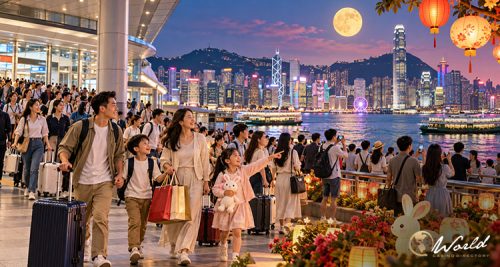
Hong Kong saw nearly 440,000 mainland Chinese visitors in one weekend, a major pre-holiday surge that's a clear signal of the larger travel wave expected during the upcoming National Day Golden Week.
Hong Kong just got a serious taste of what happens when the mainland opens up for a holiday. We're talking nearly 440,000 inbound trips from mainland China in just three days over the Mid-Autumn Festival weekend. That's a massive surge, and honestly, it's got everyone watching closely.
It feels like a prelude, doesn't it? The real test is still on the horizon. This spike in travel activity is giving us a clear preview of the crowds and the economic ripple effects we can expect when the next big holiday kicks in. Let's break down what these numbers really mean.
### The Mid-Autumn Surge by the Numbers
Hong Kong's Immigration Department recorded 439,532 inbound trips from mainland visitors from Friday through Sunday. Now, here's the context that makes that figure really pop. That huge number accounted for about one quarter of *all* inbound trips during that three-day window—which totaled a staggering 1.73 million.
Think about the logistics for a second. Transport systems across China were handling this heavy holiday traffic, moving people south. It's a massive coordination effort, and this past weekend shows they're gearing up for something even bigger. The city's streets, shops, and hotels felt that influx. It wasn't just a statistic; it was a visible, tangible wave of visitors.
### Why This Weekend Was Just a Warm-Up
All this attention is already shifting. It's pivoting to the mainland's upcoming seven-day National Day holiday, often called 'Golden Week.' If a three-day festival can bring in nearly half a million cross-border trips, what does a full week promise?
The Mid-Autumn numbers act like a crystal ball. They give tourism boards, retail sectors, and hospitality businesses in Hong Kong critical data. They can see travel patterns, spending habits, and crowd densities. This isn't just about counting people; it's about understanding the economic pulse of a connected region.
- **Retail and Hospitality:** A direct surge in customers, from luxury stores to local eateries.
- **Transportation Networks:** Stress-tested systems that need to scale for the next wave.
- **Economic Indicators:** Short-term tourism spend is a immediate boost to local GDP.
It's a fascinating case study in demand forecasting. The weekend proved the pent-up desire for travel is very much alive. The infrastructure handled it, but the question on everyone's mind is about capacity. Can it handle a longer, potentially larger, influx?
### Reading Between the Travel Lines
So what's the real story here? It's about momentum. A successful, manageable travel surge builds confidence. It tells mainland tourists that crossing the border is smooth and worthwhile. It assures Hong Kong businesses that the flow is returning.
This pre-Golden Week activity is more than just a headline. It's a signal. It hints at recovery, at reconnection, and at the sheer scale of movement possible when calendars align and borders are open. The conversations now aren't just about visitor numbers. They're about sustainability, managing crowds, and ensuring the experience remains positive for everyone involved.
That's the ultimate takeaway. This wasn't an anomaly; it was a deliberate preview. The systems worked, the people came, and the city absorbed the energy. Now, the world watches to see if this model can be replicated and expanded for the main event. The stage is set, and Hong Kong has just had its dress rehearsal.