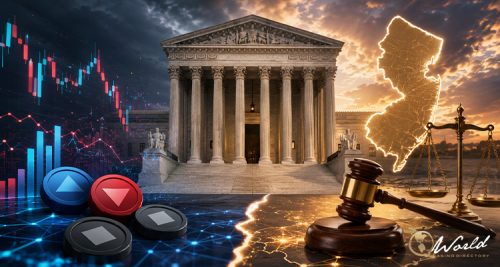
New Jersey's Supreme Court petition asks who controls prediction markets: states or federal regulators. The outcome will redefine the line between financial trading and sports gambling.
So here's the thing that's got everyone from Wall Street to Las Vegas watching closely. New Jersey isn't just asking a question—they're taking a legal dispute all the way to the top. They've formally petitioned the U.S. Supreme Court to step in and settle something that's been brewing for years. It's a classic American showdown: state power versus federal authority, but this time it's playing out in the rapidly evolving world of prediction markets.
### The Core Legal Tug-of-War
At its heart, this is about who gets to call the shots. New Jersey's position is pretty straightforward. They look at platforms like Kalshi, where you can trade contracts on everything from election outcomes to whether a specific football team will win, and they see gambling. Pure and simple. Under their state laws, that falls squarely under their regulatory umbrella. They want to treat these sports-related prediction contracts the same way they treat a wager at a casino sportsbook.
But the companies operating these markets? They see it completely differently. They argue they're not running betting shops. They're operating sophisticated financial platforms, more akin to commodities futures trading than a roulette wheel. Their stance is that these contracts are financial instruments and should fall under federal oversight, like the SEC or CFTC. It's a fundamental clash of perspectives, and right now, different federal appeals courts have landed on opposite sides of the fence.
### Why This Isn't Just Legal Jargon
Let's step back for a second. This isn't some obscure regulatory spat. Prediction markets are a big deal. They're not just for political junkies anymore. People use them to hedge risks, to gauge public sentiment on corporate earnings, or to speculate on everything from the weather to box office numbers. The potential is enormous, but so is the regulatory gray area.
- **For investors:** Clear rules mean knowing exactly what you're buying into. Is it a security? A derivative? Or is it just a fancy bet?
- **For states:** A win for New Jersey could empower other states to craft their own, potentially varied, rules for these platforms, creating a patchwork of regulations.
- **For the markets themselves:** Federal oversight might mean more legitimacy and access to bigger capital, but also stricter compliance and reporting burdens.
The conflicting court decisions have created a real mess. A company might be operating perfectly legally in one circuit, only to be in violation in another. That kind of uncertainty stifles innovation and confuses everyone involved.
### What Happens Next?
The Supreme Court doesn't have to take the case. They get thousands of petitions and only choose to hear about 100-150 each term. But the fact that there's a clear 'circuit split'—meaning federal appeals courts have directly contradicted each other—increases the odds. It's exactly the kind of situation the high court exists to resolve.
If they do take it, the ruling will set a precedent that echoes far beyond New Jersey's borders. It will answer a critical question for the digital age: When does predicting the future become a financial activity, and when is it simply gambling? The line has never been blurrier.
As one legal expert recently put it, 'We're trying to fit 21st-century technology into 20th-century legal frameworks, and the seams are bursting.' This case could determine who gets to redraw the map. For now, the industry, the states, and anyone with a stake in these markets are left in a holding pattern, waiting to see if the nation's highest court will make the final call.